
If you are like most homeowners in Maryland and Virginia, you probably don’t think about your well pump until the water stops running. By then, it’s usually an expensive emergency repair.
While submersible well pumps are designed to run for years without much attention, a little preventative maintenance can extend their life and save you thousands in premature replacement costs.
Here is the National Water Service Maintenance Checklist to keep your water flowing.
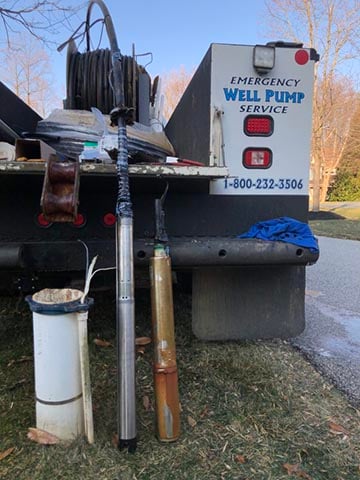
1. Inspect the Well Cap
Your first line of defense is the well cap (the cover on top of the pipe sticking out of your yard).
What to check: Ensure it is tight, secure, and not cracked.
Why: A broken cap allows insects, debris, and surface water (which carries bacteria) to fall directly into your drinking supply.
Tip: If your cap is buried, we highly recommend extending the casing above ground for easier access and safety.
2. Check Your Pressure Tank
Your well pump and pressure tank work as a team. If the tank is waterlogged, your pump will “short cycle” (turn on and off rapidly), which burns out the motor.
The Test: Go to your pressure tank (usually in the basement) and listen. Does the pump click on and off every few seconds while water is running? That is a bad sign.
Visual Check: Look for any rust or leaks around the base of the tank.
3. Listen for Weird Noises
Since submersible pumps are underground, you can’t hear them. But you can hear the controls in your basement.
-
Buzzing or clicking: If the control box is making loud buzzing sounds or clicking repeatedly without starting the pump, you may have a capacitor or relay issue.
-
Action: Call a professional immediately. Electrical issues can cause a fire or permanently damage the pump wiring.
4. Test Your Water Quality Annually
Maintenance isn’t just about the machine; it’s about the water. Water testing helps check for many water contaminants such as:
Bacteria: We recommend testing for Coliform bacteria once a year.
Sediment: If you suddenly see cloudy water or sand in your toilet tank, your well screen might be degrading, or the pump might be sitting too low in the well.
5. Protect Your Pump from Freezing
In Maryland and Northern Virginia, winter lows can freeze exposed pipes.
Check: Ensure any pipes entering the house are insulated.
Drafts: If your pressure tank is in a garage or unheated shed, make sure there are no drafts that could freeze the pressure switch (the small box that tells the pump when to turn on).
When to Call a Professional
There are some things you should never DIY. A well pump runs on high-voltage electricity and involves heavy lifting. Call National Water Service if:
You have “No Water” or very low pressure.
Your electric bill has suddenly spiked (a sign of a dying pump).
The pump is short-cycling constantly.
Need a Well Pump Check-Up?
While you can do the visual checks, our team has the tools to test the amperage, flow rate, and electrical integrity of your system.
FAQ: Well Pump Maintenance
How often should I service my well pump?
We recommend a professional inspection once a year, ideally during your annual water quality test. However, you should check your pressure tank and well cap yourself every 3-6 months to catch small issues early.
How long does a well pump last?
On average, a submersible well pump lasts 10 to 15 years. If your pump is older than 15 years and starts acting up (low pressure, noises), it is usually more cost-effective to replace it than to repair it.
Can I maintain the well pump myself?
You can (and should) do the visual checks in this checklist. However, because the pump is hundreds of feet underground and runs on high-voltage electricity, any repairs or electrical testing should be done by a licensed professional.
Can I maintain the well pump myself?
You can (and should) do the visual checks in this checklist. However, because the pump is hundreds of feet underground and runs on high-voltage electricity, any repairs or electrical testing should be done by a licensed professional.
Why is my well pump running constantly?
This usually means you have a leak in the water line, a bad check valve, or your pressure tank is waterlogged. Turn off the power to the pump immediately to prevent the motor from burning out, and call a professional.