
National Water Service provides professional water treatment services throughout Prince William County, VA — from Woodbridge, Dale City, and Dumfries to Gainesville, Haymarket, and Manassas. Prince William County has one of the most complex water supply systems in Northern Virginia, with multiple wholesale suppliers, separate east and west distribution systems, a city-operated treatment plant, community well systems, and private wells — each creating different water quality conditions depending on where you live.
In addition to Prince William County, we provide expert water treatment across Maryland, Washington DC, and Northern Virginia.
Prince William County doesn’t treat its own water. Instead, Prince William Water (Virginia’s largest combined drinking water and wastewater utility, formerly known as the Prince William County Service Authority until 2024) purchases treated drinking water from multiple suppliers and distributes it through approximately 1,300 miles of piping. Where your water actually comes from depends on which part of the county you live in:
Eastern Prince William County (Woodbridge, Dale City, Dumfries, Triangle, Lake Ridge) — Water is purchased from Fairfax Water and treated at the Frederick P. Griffith Jr. Water Treatment Plant, which draws from the Occoquan Reservoir. Virginia American Water also serves approximately 19,800 customers in the Dale City area with water purchased from Fairfax Water.
Western Prince William County (Gainesville, Haymarket, Bristow, Manassas area) — Water comes from a blend of two sources: Potomac River water treated at Fairfax Water’s James J. Corbalis Jr. Treatment Plant, and Lake Manassas water treated at the City of Manassas Water Treatment Plant. Lake Manassas is a 790-acre reservoir holding approximately 5.3 billion gallons. Prince William Water purchases 5 MGD from the City of Manassas.
Bull Run Mountain / Evergreen communities — A small cluster of customers in these neighborhoods receive water from six community groundwater wells. The well water is treated with sodium hydroxide to prevent plumbing corrosion — a distinctly different water source from the rest of the county.
City of Manassas — Operates its own independent water system, drawing from Lake Manassas and selling treated water to both its own residents and to Prince William Water for western county distribution.
Private Wells — Homes outside the distribution system — particularly in rural western and southern areas — rely on private wells drawing from Piedmont bedrock aquifers.
The water cycle in Prince William County — Prince William County has an unusual circular water system: Potomac River water is treated and sent to western county homes. The resulting wastewater goes to the Upper Occoquan Service Authority (UOSA) plant in Centreville, where it’s cleaned and discharged into Bull Run — which flows into the Occoquan Reservoir. Fairfax Water then withdraws from the Occoquan Reservoir and treats it again at the Griffith plant to supply eastern Prince William County. This means water is effectively reused within the system.
Prince William County’s water hardness depends on which supply system serves your home. Since the county purchases from Fairfax Water, the hardness range is similar: 84 to 170 mg/L (moderately hard to hard), varying by source and season.
Homes receiving Potomac-sourced water (western county) may experience different hardness levels than homes receiving Occoquan-sourced water (eastern county). Lake Manassas-blended water in the western system adds another variable.
Private wells in Prince William County draw from Piedmont bedrock and can produce hard water from limestone and carbonate rock formations, sometimes exceeding municipal supply hardness levels.
A water softener is one of the most common systems we install in Prince William County to eliminate scale, protect appliances, and improve soap performance.

At 84–170 mg/L, Prince William Water supply causes scale in water heaters, spots on glassware, and reduced soap effectiveness. Treatment: water softener.
Fairfax Water uses ozone and chloramines for disinfection. The City of Manassas also uses chloramines. Each spring, suppliers switch to free chlorine for system maintenance, which some customers notice as a stronger chlorine taste. Treatment: carbon filtration.
Chlorine-based disinfection of surface water from the Potomac and Occoquan produces trihalomethanes and haloacetic acids. Prince William Water reports levels regularly below EPA standards. Carbon filtration and reverse osmosis provide additional home-level reduction.
Prince William Water notes that older plumbing can produce metallic tastes from copper and iron corrosion, particularly in hot water or when water has been stagnant. Suppliers add corrosion inhibitors, but homes with aging pipes may benefit from reverse osmosis at the kitchen tap for drinking water.
In the 2025 Virginia General Assembly session, legislation (HB2050) was introduced to address PFAS contamination in the Occoquan Reservoir, which supplies eastern Prince William County. The EPA upheld PFAS maximum contaminant levels in May 2025. For homeowners who want protection, reverse osmosis is the most effective home treatment for PFAS.
A tasteless, odorless radioactive gas common in Maryland’s deep-rock wells. When water is used for showering or laundry, radon escapes into the air, posing a significant long-term inhalation risk. Radon reductions systems are best to combat this.
Homes outside Prince William Water’s distribution system — particularly in rural western and southern parts of the county — rely on private wells drawing from Piedmont bedrock aquifers. The Prince William Health District oversees private well permits and inspections.
Common well water issues in Prince William County include:
We provide free basic in-home water testing and can coordinate lab analysis when needed.
If you’re experiencing low water pressure or suspect your well pump or pressure tank may be failing, our well pump services team can diagnose and repair the issue.
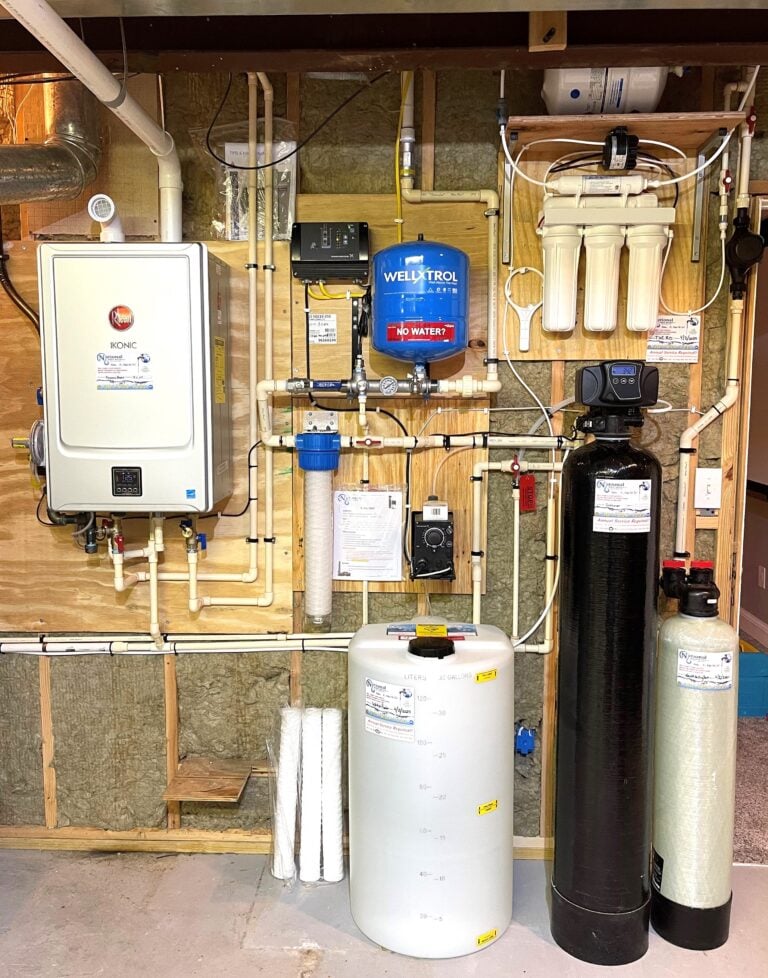
Every system we install is selected based on your water test results, household size, and plumbing configuration. We use non-proprietary equipment — meaning you’re never locked into a single brand for parts or service. Common solutions for Prince William County homes include:
We handle installation, annual maintenance and emergency service across Prince William County. Our office is in Woodbine, MD.
View our full range of water treatment services or browse our before-and-after installation gallery to see real results from homes like yours.

We provide water treatment, well pump services, and plumbing services throughout Prince William County, VA, including:
In addition to Prince William County, we provide expert water treatment across Maryland, including Montgomery County, Howard County, Frederick County, Carroll County, Baltimore County, Anne Arundel County, Prince George’s County, Loudoun County, VA, Fairfax County, VA, and Washington, DC.
It depends on your location. Eastern county (Woodbridge, Dale City) gets Occoquan Reservoir water via Fairfax Water’s Griffith plant. Western county (Gainesville, Haymarket) gets a blend of Potomac River water (via Fairfax Water’s Corbalis plant) and Lake Manassas water (via City of Manassas). Bull Run Mountain/Evergreen gets community well water. Private wells serve rural areas.
Prince William Water meets all EPA and Virginia Department of Health standards. However, the water is moderately hard to hard (84–170 mg/L) and uses chloramine disinfection that can produce taste and byproducts. Many homeowners add water softeners and carbon filtration for improved quality.
ery likely. Water hardness ranges from 84–170 mg/L depending on your source and location. A water test confirms your exact level.
PFAS in the Occoquan Reservoir (which supplies eastern Prince William County) has been a legislative focus, with HB2050 introduced in the 2025 Virginia General Assembly. The EPA upheld PFAS limits in May 2025. A reverse osmosis system provides the most effective home-level PFAS reduction.
We recommend testing for hardness, pH, iron, manganese, bacteria (coliform/E. coli), nitrates, radon, and sediment at minimum. Schedule a free water test. If you’re having pressure issues, our well pump team can inspect your system.
Yes — we serve over 20 communities throughout Prince William County. See our full list above. Our office is in Woodbine, MD. Contact us to confirm service availability.
Cost depends on the system type and your specific water conditions. We provide free in-home water testing and a detailed estimate before any work begins. Call 301-854-1333 to schedule.

Schedule your free water test today or call 301-781-5866 to speak with a water treatment specialist.