
National Water Service provides professional water treatment services throughout Washington, DC — from Georgetown and Capitol Hill to Anacostia, Tenleytown, and everywhere in between. Washington, DC has a unique water system: a federal agency treats the water, an independent authority distributes it, and the city’s aging infrastructure creates water quality challenges that many residents don’t realize they can solve at home.
In addition to Washington, DC, we provide expert water treatment across Maryland and Northern Virginia.
Montgomery County’s public water supply is managed primarily by WSSC Water (Washington Suburban Sanitary Commission), one of the largest water utilities in the United States, serving approximately 1.9 million customers across Montgomery and Prince George’s counties. WSSC operates two filtration plants that supply the county:
Potomac Water Filtration Plant — Located in Potomac, MD near Swain’s Lock, this is the larger of the two facilities. It draws water directly from the Potomac River and has a maximum treatment capacity of 280 million gallons per day (MGD). The Potomac plant supplies the majority of Montgomery County’s public water.
Patuxent Water Filtration Plant — Located in Laurel, MD, this plant draws from the Triadelphia Reservoir and the T. Howard Duckett Reservoir (also known as Rocky Gorge). It produces up to 110 MGD.
Some areas of the county receive blended water from both plants. This distinction matters for treatment because the two sources have very different water chemistry — particularly when it comes to hardness.
Two important exceptions:
Washington, DC’s water is moderately hard, typically ranging from approximately 85 to 140 mg/L (about 5–8 grains per gallon). Hardness varies seasonally — warmer months tend to produce harder water as the Potomac’s mineral content increases during lower-flow periods.
While not as hard as some of the surrounding areas we serve (Baltimore County supply reaches 185 mg/L, for example), DC’s hardness is enough to cause noticeable scale buildup in water heaters, white spots on glassware and fixtures, reduced soap lathering, and shortened appliance lifespans.
A water softener eliminates these issues. For DC condos and townhomes where space is limited, compact softener models are available.
Even though WSSC Water has maintained 107+ consecutive years with zero drinking water quality violations, that record applies to water as it leaves the treatment plant — not necessarily what comes out of your tap. Many of the water quality issues Montgomery County homeowners experience are caused by conditions inside the home or on the property.
The combination of chlorine-based disinfection and Potomac River organic matter produces trihalomethanes and haloacetic acids. Multiple contaminants including bromodichloromethane, chloroform, dibromochloromethane, and dichloroacetic acid have been detected in DC’s water. Treatment: carbon filtration whole-house and reverse osmosis at the tap.
The Washington Aqueduct uses chloramines as a secondary disinfectant. Chloramines are more stable than free chlorine (they don’t dissipate by sitting water out), so standard pitcher filters are often ineffective. Treatment: whole-house carbon filtration with catalytic carbon designed for chloramine removal. Important note: chloramines must be removed from water used in fish tanks, ponds, and dialysis — standard dechlorination products for free chlorine are not sufficient.
DC’s lead history is among the most documented in the country. In 2001, lead levels as high as 1,250 ppb were discovered — roughly 83 times the EPA action level of 15 ppb. The crisis was traced to the Aqueduct’s switch from chlorine to chloramine disinfection, which corroded lead solder and service lines throughout the system. The Aqueduct subsequently added orthophosphate as a corrosion inhibitor, which significantly reduced lead leaching. DC Water’s Lead Free DC program (launched 2019) is actively replacing lead service lines at no cost to homeowners, but many homes built before the 1980s may still have lead service lines or lead solder in their plumbing. A reverse osmosis system at the kitchen tap provides the most effective home-level lead reduction for drinking and cooking water.
Washington, DC is one of approximately 772 older cities in the country with a combined sewer system, meaning stormwater and sewage flow through the same pipes. During heavy rain, the system can overflow into the Potomac River, Anacostia River, and Rock Creek. DC Water’s Clean Rivers Project — a nearly $3 billion infrastructure program — is constructing over 18 miles of deep tunnels (larger than Metro tunnels, more than 100 feet underground) to capture overflows and route them to Blue Plains for treatment. The Potomac River Tunnel, currently under construction with completion expected by 2030, will reduce Potomac CSO events from approximately 74 per year to just 4 and cut overflow volume by 93%. While CSOs primarily affect the waterways rather than tap water, they represent DC’s largest ongoing water infrastructure investment.
Like most systems drawing from the Potomac, DC’s water may contain trace PFAS compounds. A reverse osmosis system provides the most effective home-level PFAS reduction.
DC Water manages pipes that in some cases date back over a century. Aging cast iron mains can contribute to discolored water events, and the system’s age increases vulnerability to main breaks and service interruptions, particularly during extreme weather.
At 85–140 mg/L, DC’s water leaves mineral deposits on fixtures, reduces water heater efficiency, and creates soap scum. Treatment: water softener.
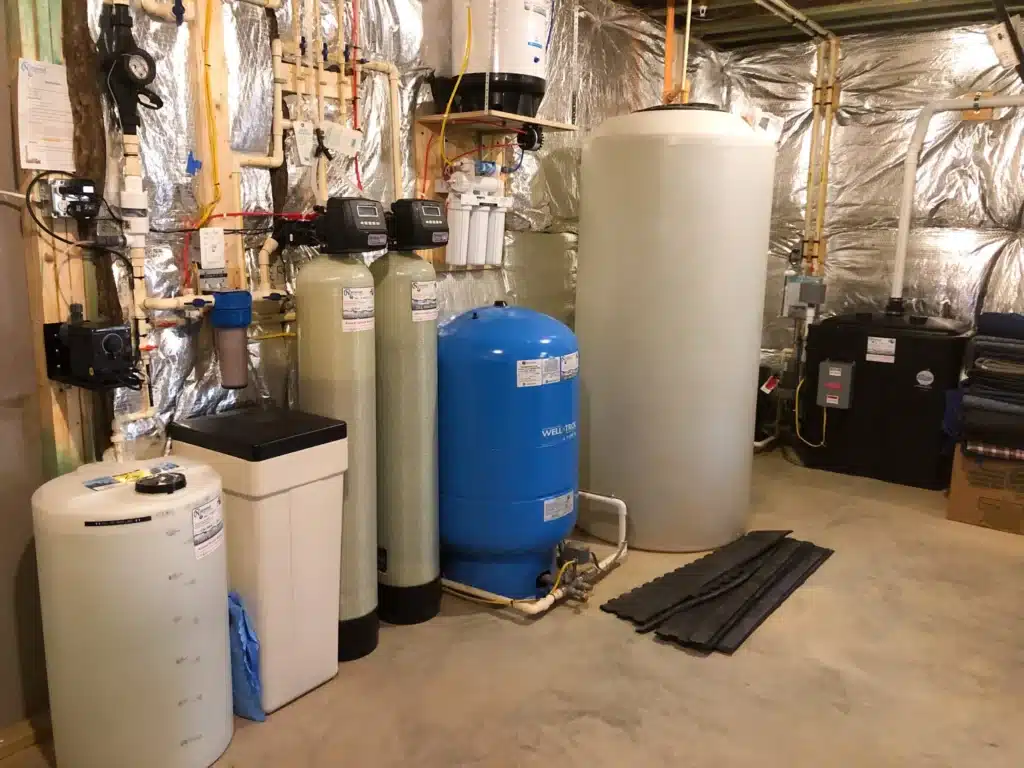
Every system we install is selected based on your water test results, household size, and plumbing configuration. For DC’s many row houses, condos, and townhomes, we offer compact systems that fit in tight mechanical spaces. We use non-proprietary equipment — meaning you’re never locked into a single brand for parts or service.
Common solutions for Washington, DC homes include:
We handle installation, annual maintenance and emergency service across Washington, DC. Our office is in Woodbine, MD.
View our full range of water treatment services or browse our before-and-after installation gallery to see real results from homes like yours.
We provide water treatment services throughout all quadrants and neighborhoods of Washington, DC, including:
In addition to Washington, DC, we provide expert water treatment across Maryland and Northern Virginia, including Montgomery County, MD, Howard County, MD, Frederick County, MD, Carroll County, MD, Baltimore County, MD, Anne Arundel County, MD, Prince George’s County, MD, Loudoun County, VA, Fairfax County, VA, and Prince William County, VA.
All of DC’s drinking water comes from the Potomac River. The Washington Aqueduct (U.S. Army Corps of Engineers) draws approximately 140 million gallons per day from Great Falls and Little Falls intakes, treats it at the Dalecarlia and McMillan plants, and DC Water distributes it through 1,300+ miles of pipes to over 700,000 customers.
DC Water meets EPA standards and the Aqueduct adds orthophosphate to control lead corrosion. However, the water is moderately hard, contains chloramines, produces disinfection byproducts, and may pass through aging infrastructure including legacy lead service lines. Many DC homeowners and condo owners add carbon filtration and reverse osmosis for improved quality at the tap.
If your home was built before the 1980s, it may have a lead service line or lead solder in the plumbing. DC Water’s Lead Free DC program is replacing lead lines at no cost, but the work takes time. A reverse osmosis system at the kitchen tap provides immediate protection for drinking and cooking water. You can check your service line status on DC Water’s Lead Map or call them at 202-787-4044 for a free lead test.
DC’s water ranges from 85–140 mg/L hardness depending on season. If you notice white spots on glassware, scale on fixtures, or reduced soap lathering, a water softener will solve it. Compact models are available for DC’s row houses and condos.
Most standard pitcher filters and refrigerator filters are designed for free chlorine, not chloramines. Chloramines require catalytic carbon filtration or a reverse osmosis system for effective removal. Unlike free chlorine, chloramines don’t dissipate by leaving water in an open container.
DC Water’s nearly $3 billion infrastructure program to reduce combined sewer overflows. The project is constructing 18+ miles of deep tunnels to capture stormwater and sewage before it reaches the Potomac, Anacostia, and Rock Creek. The Potomac River Tunnel (completion ~2030) will reduce CSO events by 93%. While this doesn’t directly affect tap water quality, it represents the city’s largest water infrastructure investment.
Yes — we install compact water treatment systems designed for DC’s smaller mechanical spaces. Contact us to discuss options for your specific setup.
Cost depends on the system type and your specific water conditions. We provide free in-home water testing and a detailed estimate before any work begins. Call 301-854-1333 to schedule.

Schedule your free water test today or call 301-781-5866 to speak with a water treatment specialist.