
National Water Service provides professional water treatment services across Maryland — from the WSSC-supplied suburbs of Montgomery and Prince George’s Counties to the private well communities of Frederick, Carroll, and western Howard County. We’ve been solving Maryland’s water problems for over 47 years with custom-designed, non-proprietary treatment systems built for the specific water conditions in your county, your neighborhood, and your home.
Our office is in Woodbine, MD. We serve residential and commercial customers throughout central Maryland. Schedule a free water test or call 301-781-5866.
Licensed Water Treatment Professionals Serving Every County in Maryland.

Maryland’s water landscape is uniquely complex. Within our service area alone, homeowners draw water from at least four different major utilities, dozens of independent municipal systems, and thousands of private wells — each with different source water, treatment processes, and quality characteristics.
A water softener that’s perfect for a home on WSSC’s Potomac River supply in Bethesda may be completely wrong for a well in Thurmont. An acid neutralizer that’s essential in Carroll County’s Piedmont bedrock may be unnecessary for a home on Baltimore City reservoir water in Columbia. That’s why every system we install starts with a professional water test — and why we’ve invested 47 years in understanding Maryland’s local water conditions county by county.
Understanding who supplies your water is the first step toward choosing the right treatment. Here’s a quick overview of the major systems across our Maryland service area:
WSSC Water (Washington Suburban Sanitary Commission) — Serves approximately 1.9 million customers in Montgomery and Prince George’s Counties. Draws from the Potomac River and Patuxent River. Uses chloramine for disinfection. Potomac-sourced water is hard (120–130 mg/L); Patuxent-sourced water is softer (60–65 mg/L). WSSC has maintained 107+ consecutive years with zero drinking water quality violations. → Montgomery County water treatment | Prince George’s County water treatment
Baltimore City — Supplies water to Baltimore County and Howard County (75% of Howard County’s supply) through its reservoir system: Liberty Reservoir, Loch Raven Reservoir, and Prettyboy Reservoir. Baltimore City water tends to be hard (up to 185 mg/L) and has documented levels of disinfection byproducts (haloacetic acids and trihalomethanes) from chlorine treatment of surface water. → Howard County water treatment | Baltimore County water treatment
City of Frederick — Draws from the Monocacy River, Linganore Creek, and Fishing Creek Reservoir. The county’s New Design Water Treatment Plant also draws from the Potomac River. Water averages approximately 99 mg/L hardness. The Monocacy watershed runs through over 60% cropland, making agricultural contamination a concern. → Frederick County water treatment
Carroll County / Freedom District — The Freedom District Water Treatment Plant draws from Liberty Reservoir (owned by Baltimore City) using membrane filtration technology, producing up to 4.0 MGD. Seven additional incorporated towns (Westminster, Hampstead, Manchester, Taneytown, Mt. Airy, New Windsor, Union Bridge) each operate their own independent systems. Carroll County has one of the highest percentages of private well users in our service area. → Carroll County water treatment
Anne Arundel County — Served by Anne Arundel County Department of Public Works, with water sourced from a combination of surface water and groundwater. → Anne Arundel County water treatment
Private Wells — Approximately 350,000 Maryland households rely on private wells as their drinking water source. These are not monitored or treated by any government agency — the homeowner is fully responsible. Private well water quality depends entirely on local geology, well depth, and nearby land use. The Maryland Department of the Environment recommends annual testing for all private well owners.
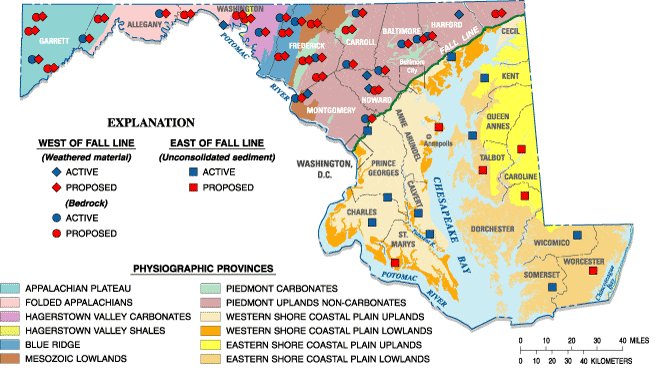
Maryland’s water quality is shaped by its geology, which changes dramatically across the state. Understanding which geological region your home sits in helps explain why your water behaves the way it does.
Piedmont Plateau (Central Maryland) — Covering about 90% of Howard County and large portions of Montgomery, Carroll, Frederick, and Baltimore Counties. The Piedmont consists of highly metamorphosed crystalline rock, limestone formations, and carbonate bedrock. Wells in this region commonly produce hard water, low-pH (acidic) water, iron, manganese, and in some areas, radon. Limestone areas in the Frederick Valley and parts of Carroll County can produce very hard water. This is where the majority of our Maryland customers are located.
Blue Ridge Province (Western Frederick County) — The Catoctin Mountain area and western Frederick County sit on older rock formations that can produce low-pH water, iron, and elevated radon in well water. Wells here tend to be deeper and can have variable yield.
Triassic Lowland (Northern Frederick County / parts of Carroll County) — Sandstone and shale formations with good groundwater storage capacity. Wells in this region may produce hard water and iron, but water chemistry differs from the Piedmont crystalline rock areas.
Coastal Plain (Eastern Anne Arundel County / parts of Prince George’s County) — Sandy soils and aquifer-based water sources. Saltwater intrusion from the Chesapeake Bay can increase sodium and chloride levels in coastal wells. Water chemistry here is different from the Piedmont counties.
Even though WSSC Water has maintained 107+ consecutive years with zero drinking water quality violations, that record applies to water as it leaves the treatment plant — not necessarily what comes out of your tap. Many of the water quality issues Montgomery County homeowners experience are caused by conditions inside the home or on the property.
The most widespread issue across Maryland. WSSC Potomac-sourced water averages 120–130 mg/L, Baltimore City supply can reach 185 mg/L, and private wells in limestone areas can be even harder. Hard water causes scale buildup in water heaters and on fixtures, spots on glassware, and reduced soap effectiveness. Treatment: water softener.
Common in wells across the Piedmont region, particularly in Carroll, Frederick, and western Howard Counties. Acidic water corrodes copper pipes, causes blue-green staining, and can leach metals into drinking water. Treatment: acid neutralizer.
Prevalent in well water throughout central Maryland. Iron causes orange/brown staining; manganese causes black staining. Treatment: iron breaker / sulfur breaker.
Common in certain well water formations, particularly in Frederick and Carroll Counties. Treatment: iron breaker / sulfur breaker.
Affects homes on WSSC, Baltimore City, and other municipal supplies. WSSC uses chloramine (which doesn’t evaporate like free chlorine). Treatment: carbon filtration.
Documented in Baltimore City-supplied water (which serves Howard and Baltimore Counties) and City of Frederick water. These form when chlorine reacts with organic matter in surface water sources. Treatment: carbon filtration and reverse osmosis.
Risk for private well owners, particularly in agricultural areas of Frederick and Carroll Counties where farm runoff and septic systems can contaminate groundwater. Treatment: UV disinfection or chemical feeder.
A concern in Maryland’s farming communities, especially Frederick County where over 60% of the Monocacy watershed is cropland. Dangerous for infants above the EPA limit of 10 mg/L. Treatment: reverse osmosis.
Frederick County has been testing since 2021. WSSC monitors PFAS at both filtration plants. Treatment: reverse osmosis.
Found in deep-rock wells across Maryland’s Piedmont region, particularly in Carroll, Frederick, and western Howard Counties. Radon is a tasteless, odorless radioactive gas that becomes an inhalation risk during showering and laundry. Treatment: radon removal system.
Common in well water throughout Maryland, especially after heavy rain. Treatment: sediment filtration.
Water quality varies significantly from county to county across Maryland. We’ve built detailed guides for each county we serve — covering your specific water source, local water quality data, common issues, and recommended solutions. Click your county below:
Every system we install follows a proven 4-step approach:
We start with a comprehensive water test to identify exactly what’s in your water — minerals, bacteria, pH, hardness, and contaminants specific to your county and water source. Schedule your free water test.
You receive a detailed water analysis report in plain English. We explain what was found, how it affects your home and health, and what solutions are appropriate — no pressure, no upselling.
We design a non-proprietary treatment system specifically for your water chemistry. No locked-in service contracts, no proprietary parts — just transparent, long-lasting solutions installed by our certified technicians.
We provide ongoing maintenance including filter changes, media replacement, and system inspections to keep your water quality consistent year after year.
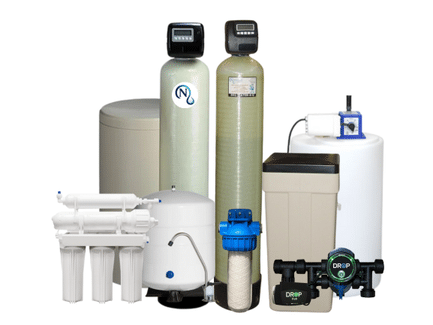
We install a full range of non-proprietary water treatment equipment for both residential and commercial properties:
We also provide commercial water treatment for restaurants, offices, schools, care facilities, and industrial properties.
View our before-and-after installation gallery to see real results from Maryland homes.
We serve homeowners across the entire state. Click your county below for more information on water treatment conditions.
It depends entirely on your water source and location. Homes on WSSC typically need water softeners and carbon filtration. Homes on Baltimore City supply often benefit from softening and carbon filtration for disinfection byproducts. Private well owners in central Maryland commonly need some combination of acid neutralizers, iron removal, water softeners, and UV disinfection. A free water test is the only way to know for sure.
It can be, but it depends on your specific well and location. Approximately 350,000 Maryland households rely on private wells, and the state recommends annual testing. Well water is not monitored or treated by any government agency — the homeowner is solely responsible. Common issues in Maryland wells include low pH, iron, bacteria, hardness, and radon. Professional testing identifies problems before they affect your health.
WSSC water from the Potomac River averages 120–130 mg/L — classified as hard by USGS standards. WSSC water from the Patuxent River is softer at 60–65 mg/L. Which plant serves your home depends on your location within Montgomery or Prince George’s County. See our Montgomery County guide for details.
Yes — Baltimore City water from Liberty Reservoir and Loch Raven Reservoir can reach approximately 185 mg/L, which is hard. This affects Howard County (which purchases 75% of its water from Baltimore City) and Baltimore County. See our Howard County guide for details.
Cost varies based on the system type and your specific water conditions. A single acid neutralizer is a different investment than a comprehensive multi-stage system with softening, iron removal, and UV disinfection. We provide free in-home water testing and a detailed estimate before any work begins — no pressure, no obligation. Call 301-854-1333 to schedule.
Yes — we provide complimentary basic in-home water testing throughout our Maryland service area. We can also coordinate comprehensive lab analysis for bacteria, nitrates, radon, PFAS, and other contaminants when needed. Schedule your free test.
If you see blue or teal-colored staining on your fixtures, your water is likely acidic (low pH). This “hungry” water is leaching copper from your home’s plumbing. If left untreated, this leads to pinhole leaks in your pipes. An Acid Neutralizer is the standard Maryland solution for this problem.
Yes, particularly in agricultural heavyweights like Carroll, Frederick, and the Eastern Shore. Nitrates from fertilizers can seep into the groundwater. Because nitrates are odorless and colorless, they can only be detected through professional testing. High levels are a significant health concern for infants and pregnant women.
Maryland is unique because it spans multiple geological zones. If you live in the Piedmont (Central MD), you likely have “fractured rock” wells that are mineral-heavy. If you are in the Coastal Plain (Southern MD/Eastern Shore), your water travels through sand and gravel, which often leads to higher acidity and iron levels.
When engineered correctly, a professional filtration system should have no noticeable impact on your home’s water pressure. We size every system based on your home’s peak flow rate to ensure you can run the shower, dishwasher, and laundry simultaneously without a drop in performance.
We serve Montgomery County, Howard County, Frederick County, Carroll County, Baltimore County, Anne Arundel County, and Prince George’s County in Maryland, plus Loudoun County, Fairfax County, and Prince William County in Northern Virginia, and Washington, DC. Our office is in Woodbine, MD. Contact us to confirm service in your area.

Don't settle for "okay" water. Get the clean, crisp water your family deserves from the most trusted Maryland water treatment company.