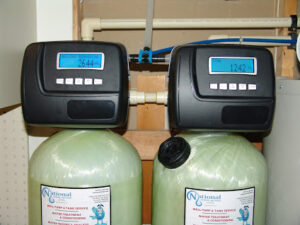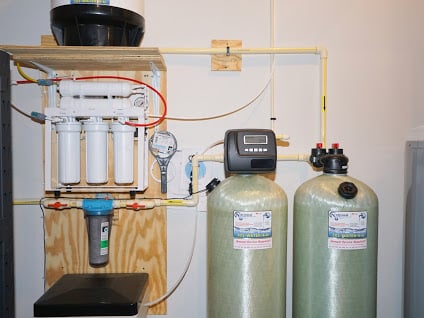
A lot of people either do not know or understand what Water Treatment equipment they have and what each systems purpose is. The two systems most commonly installed are an Acid Neutralizer and a Water Softener.
A Neutralizer and a Softener work together to balance the pH of your water. Most importantly, they remove unwanted contaminants from your water.
The Neutralizer is designed to raise your pH using a food grade calcium, called calcite. As water passes through the unit, it dissolves the calcite and the water becomes neutral. This helps in eliminating corrosion of your plumbing and appliances. However, a Neutralizer can sometimes raise the pH more then the desired amount.
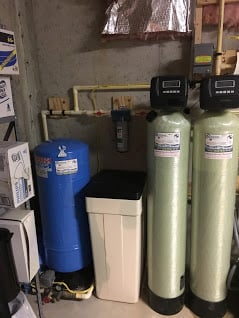
In order to find and maintain that perfect pH balance a Water Softener uses a process called ion exchange. A specific resin is added to the tank that eliminates dissolved minerals such as calcium, iron, magnesium, and manganese. A Softener uses a brine or salt tank to clean the resin.
All of our Neutralizer’s and Softener’s are installed with Clack Valve Head’s that regulate and monitor the amount of water passing through the system, when the Softener needs to backwash (clean the resin) as well as when service is required.