
National Water Service provides professional water treatment services across Northern Virginia — from the rapidly growing suburbs of Loudoun County to the established communities of Fairfax County and the complex multi-supplier system in Prince William County. We’ve been solving water problems for over 47 years with custom-designed, non-proprietary treatment systems built for the specific water conditions in your county, your neighborhood, and your home.
Our office is in Woodbine, MD, and we serve residential and commercial customers throughout Northern Virginia. Schedule a free water test or call 301-854-1333.

Northern Virginia’s water supply looks unified on the surface — most of the region draws from the Potomac River — but the reality is far more complex. Three separate counties are served by different combinations of utilities, independent systems, community wells, and private wells, each producing different water chemistry at the tap.
A home in eastern Loudoun County on Loudoun Water’s system has different water than a home in western Loudoun on a private well. A family in Woodbridge drinking Occoquan Reservoir water (eastern Prince William County) has different water than their neighbors in Gainesville drinking a Potomac/Lake Manassas blend (western Prince William County). And Fairfax County — served by the region’s largest utility — still has over 12,000 private wells scattered across its less-developed areas.
That’s why every system we install starts with a professional water test — and why we’ve invested years in understanding Northern Virginia’s local water conditions county by county.
Understanding who supplies your water is the first step toward choosing the right treatment. Here’s a quick overview of the major systems across our Northern Virginia service area:
Fairfax Water — The largest non-profit water utility in Virginia, serving approximately 2 million people across Fairfax County and portions of Prince William, Loudoun, and the independent cities of Fairfax, Falls Church, and Alexandria. Operates two major treatment plants: the James J. Corbalis Jr. Plant on the Potomac River (225 MGD capacity — the largest in Virginia) and the Frederick P. Griffith Jr. Plant on the Occoquan Reservoir (120 MGD). Also purchases supplemental water from the Washington Aqueduct. Fairfax Water introduced ozone treatment in 2000 — a Virginia first — and uses chloramines for secondary disinfection. Hardness ranges from 84–170 mg/L depending on source and season. → Fairfax County water treatment | Prince William County water treatment
Loudoun Water — Serves Loudoun County through a combination of purchased Fairfax Water supply and its own treatment capacity. Operates the Trap Rock Water Treatment Facility and recently acquired the Town of Leesburg’s water system (now the Kenneth B. Rollins Water Treatment Facility, 4.4 MGD). A Potomac River Water Supply Project is planned to eventually provide Loudoun Water its own independent Potomac intake. → Loudoun County water treatment
Prince William Water — Virginia’s largest combined drinking water and wastewater utility (rebranded from the Prince William County Service Authority in 2024). Doesn’t treat any water — purchases wholesale from Fairfax Water and the City of Manassas. Operates separate east and west distribution systems. The eastern system receives Occoquan Reservoir water; the western system receives a blend of Potomac and Lake Manassas water. Community wells serve the Bull Run Mountain and Evergreen areas. → Prince William County water treatment
City of Manassas — Operates an independent water system drawing from Lake Manassas (790 acres, 5.3 billion gallons). Sells treated water to both Manassas residents and Prince William Water for western county distribution.
Virginia American Water — A private utility serving approximately 19,800 customers in the Dale City area of Prince William County, purchasing water from Fairfax Water.
Washington Aqueduct — Owned by the U.S. Army Corps of Engineers, supplies treated Potomac River water to Washington, DC, Arlington County, and Falls Church. Fairfax Water also purchases supplemental supply from the Aqueduct. The McMillan and Dalecarlia treatment plants produce approximately 140 MGD. → Washington, DC water treatment
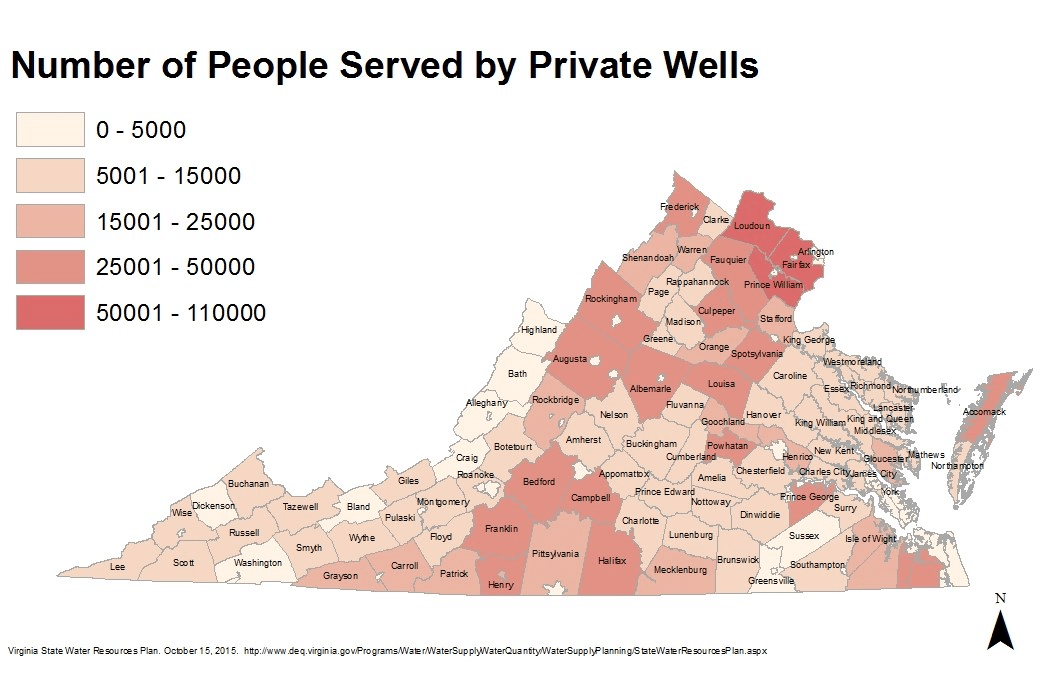
Private Wells — Thousands of Northern Virginia homes rely on private wells, particularly in western Loudoun County (horse country and vineyard communities west of Route 15), rural areas of Prince William County, and pockets of Fairfax County (which alone has over 12,750 documented private wells). Well water quality varies dramatically based on local geology.
Northern Virginia sits at the intersection of three geological provinces, and your well water chemistry depends entirely on which one your home sits above:
Piedmont Province (Eastern Loudoun, Most of Fairfax, Eastern Prince William) — Metamorphosed crystalline rock including schist, gneiss, and granite. Wells in this region commonly produce hard water, iron, manganese, and can have variable yield. This is where most of Northern Virginia’s population lives and where the majority of the private wells are located.
Triassic Lowland / Limestone Valley (Central Loudoun, Frederick Valley extension) — Limestone and carbonate bedrock that produces very hard water and can yield significant calcium and magnesium. This transition zone runs through parts of Loudoun County between the Piedmont and the Blue Ridge.
Blue Ridge Province (Western Loudoun) — Older, harder rock formations along the Blue Ridge Mountains produce wells with lower pH (acidic water), iron, and in some cases elevated radon levels. Western Loudoun’s farm and vineyard communities frequently sit on this geology.
Homes on public water don’t need to worry about geology directly — Fairfax Water and Loudoun Water treat the raw source water before distribution. But the Potomac River itself picks up minerals as it flows through these formations, which is why the regional water tends toward moderate-to-hard hardness.
The most widespread issue. Fairfax Water supply ranges from 84–170 mg/L. Loudoun Water customers and Prince William Water customers experience similar levels since most of the region’s water originates from the Potomac River or Occoquan Reservoir. Private wells in limestone areas can exceed these numbers. Hard water causes scale in water heaters, spots on fixtures, and reduced soap lathering. Treatment: water softener.
Fairfax Water, Loudoun Water, Prince William Water, and the City of Manassas all use chloramines for secondary disinfection. Each spring, suppliers temporarily switch to free chlorine for system maintenance, which some residents notice as a stronger taste. Chloramines are more persistent than free chlorine — they don’t evaporate from standing water and standard pitcher filters are often ineffective. Treatment: carbon filtration with catalytic carbon.
Surface water treatment with chlorine-based disinfectants produces trihalomethanes and haloacetic acids. These are monitored and regulated, but homeowners who want additional reduction can install carbon filtration whole-house and reverse osmosis at the kitchen tap.
PFAS in the Occoquan Reservoir has been a legislative focus, with Virginia’s HB2050 (2025) introduced to address contamination. Fairfax Water has been monitoring and treating for PFAS. For homeowners who want additional protection, reverse osmosis is the most effective home-level treatment.
Common in Piedmont and Blue Ridge wells, causing orange/brown (iron) or black (manganese) staining on fixtures, laundry, and toilets. Treatment: iron breaker / sulfur breaker.
Prevalent in Blue Ridge and western Piedmont wells, particularly in western Loudoun County. Acidic water corrodes copper pipes, leaches metals, and causes blue-green staining. Treatment: acid neutralizer.
Found in certain rock formations across the region. Treatment: iron breaker / sulfur breaker.
Risk from septic systems, agricultural runoff, and surface water intrusion, particularly in rural Loudoun and Prince William Counties. Treatment: UV disinfection or chemical feeder.
Deep Piedmont and Blue Ridge wells can contain elevated radon levels. Treatment: radon removal system.
Common in both well water and older municipal distribution systems. Treatment: sediment filtration.
Water quality varies significantly depending on which county — and which part of that county — you live in. We’ve built detailed guides for each Northern Virginia county we serve, covering your specific water source, local water quality data, common issues, and recommended solutions. Click your county below:
We also serve seven Maryland counties. Visit our Maryland water treatment hub or jump directly to your county:
Every system we install follows a proven 4-step approach:
We start with a comprehensive water test to identify exactly what’s in your water — minerals, bacteria, pH, hardness, and contaminants specific to your county and water source. Schedule your free water test.
You receive a detailed water analysis report in plain English. We explain what was found, how it affects your home and health, and what solutions are appropriate — no pressure, no upselling.
We design a non-proprietary treatment system specifically for your water chemistry. No locked-in service contracts, no proprietary parts — just transparent, long-lasting solutions installed by our certified technicians.
We provide ongoing maintenance including filter changes, media replacement, and system inspections to keep your water quality consistent year after year.
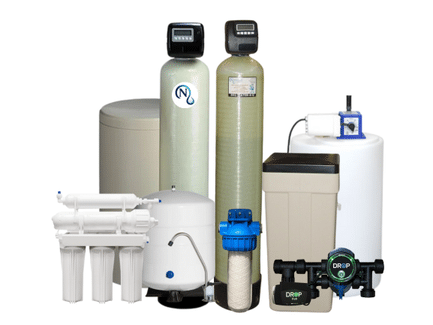
We install a full range of non-proprietary water treatment equipment for both residential and commercial properties:
We also provide commercial water treatment for restaurants, offices, schools, care facilities, and industrial properties.
View our before-and-after installation gallery to see real results from Northern Virginia homes.
It depends entirely on your water source and location. Homes on Fairfax Water, Loudoun Water, or Prince William Water typically need water softeners for hardness and carbon filtration for chloramine removal. Private well owners — particularly in western Loudoun and rural Prince William — commonly need some combination of acid neutralizers, iron removal, water softeners, and UV disinfection. A free water test is the only way to know for sure.
Yes. Fairfax Water supply ranges from 84–170 mg/L — moderately hard to hard depending on source and season. Loudoun Water and Prince William Water customers experience similar levels since most regional water originates from the Potomac River. Private wells in limestone areas can be even harder. See our Fairfax County, Loudoun County, or Prince William County guides for county-specific data.
PFAS has been a focus in the region, particularly around the Occoquan Reservoir. Virginia’s HB2050 legislation (2025) targeted PFAS contamination in Occoquan, which supplies eastern Prince William County and parts of Fairfax County via the Griffith plant. Fairfax Water has been monitoring and treating for PFAS. A reverse osmosis system provides the most effective home-level PFAS reduction.
We recommend testing for hardness, pH, iron, manganese, bacteria (coliform/E. coli), nitrates, radon, and sediment at minimum. Western Loudoun wells in particular should test for low pH and radon. Schedule a free water test. If you’re having pressure issues, our well pump team can inspect your system.
We serve Loudoun County, Fairfax County, and Prince William County in Northern Virginia, plus Washington, DC, and seven Maryland counties. Our office is in Woodbine, MD. Contact us to confirm service availability.
Cost varies based on the system type and your specific water conditions. A single water softener is a different investment than a multi-stage well water system with acid neutralization, iron removal, and UV disinfection. We provide free in-home water testing and a detailed estimate before any work begins — no pressure, no obligation. Call 301-854-1333 to schedule.
If you see blue or teal-colored staining on your fixtures, your water is likely acidic (low pH). This “hungry” water is leaching copper from your home’s plumbing. If left untreated, this leads to pinhole leaks in your pipes. An Acid Neutralizer is the standard Maryland solution for this problem.
Yes — we provide complimentary basic in-home water testing throughout our Northern Virginia service area. We can also coordinate comprehensive lab analysis for bacteria, nitrates, radon, PFAS, and other contaminants when needed. Schedule your free test.

Don't settle for "okay" water. Get the clean, crisp water your family deserves from the most trusted Northern Virginia water treatment company.